


Career Journeys in Talent Acquisition: Jeffrey Davis
- Sean Allen
- Dec 16, 2025
- 8 min read

Thanks for reading! This series is designed to shine a spotlight on Talent Acquisition professionals and highlight their career journeys and learnings so far. Today, we're joined by Career Journeys in Talent Acquisition: Jeffrey Davis. If you'd like to be next, please reach out to a TTC Community Manager.
Introduce yourself in one sentence:
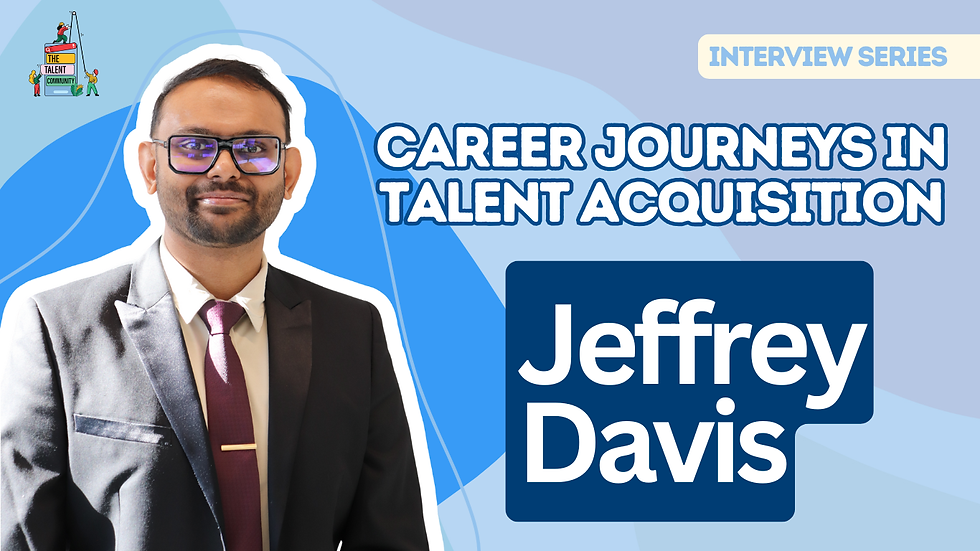
Jeffrey Davis is a global Talent Acquisition professional based in the UK, with over five years of experience building and scaling diverse tech teams across regions, specialising in full cycle hiring, early careers, and recruitment programme delivery. Please feel free to connect with me on linkedin.com/in/jeffreydavisuk.
Can you walk us through the key milestones in your career in the talent acquisition space? What were some pivotal moments or decisions that shaped your journey?
My journey into talent acquisition began somewhat organically, rooted in my early exposure to business operations and people dynamics at Amazon, where I developed a strong appreciation for process, data, and how individual roles connect to larger organisational outcomes. This foundation led me to Freshworks, which became a defining chapter in my career. At Freshworks, I transitioned fully into talent acquisition and grew rapidly, supporting large scale hiring across GTM, Product, Engineering, and Corporate functions. One of the most pivotal moments during this phase was being trusted to build and scale teams from the ground up, including expanding a Customer Success organisation from 20 to 60 members in just 60 days, which taught me the importance of structured hiring, stakeholder alignment, and candidate experience at scale.
As my confidence and expertise grew, I became increasingly involved in recruitment programme management, leading initiatives such as Employee Referral Programmes, Internal Mobility, and ATS implementation projects. Driving the adoption of SmartRecruiters in partnership with Accenture was a particularly transformative experience, as it shifted my perspective from being purely delivery focused to thinking more strategically about systems, scalability, and long term talent infrastructure. This phase helped me understand how strong hiring outcomes are often the result of well designed processes rather than individual effort alone.
Following this, my roles at Turing and Diligent Corporation further strengthened my exposure to global hiring models and remote first talent strategies, where I worked closely with international stakeholders across multiple time zones. These experiences sharpened my ability to adapt hiring approaches based on geography, culture, and business maturity, while maintaining consistency in quality and fairness. A key decision during this stage was to pursue formal academic grounding through an MSc in Human Resource Management in the UK, which allowed me to contextualise my practical experience within employment law, ethics, diversity, and international HR frameworks.
Looking back, the most pivotal moments in my journey have been those where I stepped slightly outside my comfort zone, whether it was taking ownership of high impact hiring programmes, leading change initiatives, or relocating to the UK to deepen my professional and academic exposure. Each transition reinforced my belief that effective talent acquisition sits at the intersection of people, process, and purpose, and that mindset continues to shape how I approach my work today.
In this rapidly evolving industry, what strategies or practices have you adopted to continuously enhance your skills and stay ahead of the curve? Do you have any resources or learning methods you'd recommend to others?
Talent acquisition is an industry where learning happens most effectively at the intersection of practice, reflection, and curiosity, and I have been quite intentional about building habits around all three. On the practical side, I actively seek exposure beyond day to day hiring by getting involved in projects such as ATS implementations, programme design, and process improvement initiatives. Working on initiatives like SmartRecruiters implementation and internal mobility frameworks pushed me to understand hiring systems end to end, rather than just my individual role within them.
From a skills development perspective, I make it a point to stay close to both data and people. I regularly review hiring metrics, funnel performance, and candidate experience feedback to identify patterns and areas for improvement. At the same time, I invest in strengthening my stakeholder conversations by seeking feedback from hiring managers and peers, which helps me continuously refine how I influence, advise, and partner with the business. This balance between quantitative insight and human judgement has been central to my growth.
Formal learning has also played an important role. Completing certifications such as the Josh Bersin Academy’s Talent Acquisition Crossroads helped me contextualise industry shifts around skills based hiring, automation, and the evolving recruiter role. More recently, pursuing an MSc in Human Resource Management in the UK has allowed me to ground my experience in employment law, ethics, diversity, and international HR theory, which has been particularly valuable when working across geographies.
For resources, I tend to recommend a mix of curated content and community driven learning. Platforms like the Josh Bersin Academy, CIPD publications, LinkedIn Learning and select TA focused newsletters like the TTC’s, provide strong strategic insight, while peer conversations, industry events, and practitioner communities often offer the most practical learning. My biggest recommendation to anyone in this space is to remain intentionally curious, volunteer for projects that stretch you, and treat every hiring challenge as a learning opportunity rather than a transactional task. Over time, that mindset compounds and keeps you relevant in an industry that is constantly evolving.
What has been the most challenging aspect of your career in talent acquisition, especially when you were actively seeking work? How did you overcome it, and what advice would you offer to others facing similar hurdles?
One of the most challenging aspects of my career in talent acquisition came during periods when I was actively seeking work myself, particularly while transitioning across geographies and markets. Coming from a strong delivery background, it was initially difficult to reconcile the reality that even experienced recruiters can face prolonged uncertainty, limited responses, or misalignment between their capabilities and how the market perceives them. Experiencing the hiring process from the candidate side was both humbling and eye opening, as it highlighted how timing, visibility, and context often matter just as much as capability.
What helped me navigate this phase was reframing the situation from a place of self-doubt to one of strategic repositioning. I became more intentional about how I articulated my value, not just in terms of roles I had filled, but the business problems I had solved, the teams I had built, and the systems I had improved. I invested time in strengthening my narrative, building genuine connections rather than transactional outreach, and staying engaged with the industry through learning, projects, and academic study rather than pausing growth while waiting for the next opportunity.
Another important factor was resilience and routine. Treating the job search itself like a structured project helped me maintain momentum and confidence. I set small, achievable goals, continued to upskill, and sought feedback wherever possible. Importantly, I reminded myself that rejection in recruitment rarely reflects personal failure, but rather timing, internal constraints, or shifting priorities within organisations.
For others facing similar challenges, my advice would be to stay anchored in your long-term value rather than short-term outcomes. Be honest about where you are, but intentional about where you want to go. Use periods of transition to refine your story, deepen your skills, and build meaningful relationships. Most importantly, do not underestimate the emotional resilience required in this profession, especially when you are on the other side of the hiring table. That perspective, while challenging, often makes you a more empathetic and effective recruiter in the long run.
The recruiting world can be fast-paced and demanding. How do you strike a balance between your professional commitments and personal life? Are there specific routines or rituals you follow?
Recruitment is inherently fast paced, and I have learned over time that balance is less about perfect separation and more about intentional integration. Early in my career, I often equated being constantly available with being effective, but experience has taught me that sustained performance comes from managing energy rather than hours. Today, I am more deliberate about setting realistic boundaries while remaining accountable to the people I work with.
One routine that has helped me significantly is structuring my day around priority windows. I try to front load tasks that require deeper focus, such as stakeholder conversations or planning, and leave reactive work for specific blocks rather than allowing it to spill across the day. This approach helps me stay present at work while avoiding mental fatigue. I also make it a point to close loops before the end of the day, even if it is just a brief update, as that reduces carry over stress into personal time.
Outside of work, I consciously create small but consistent rituals that help me reset. These are not elaborate routines, but simple habits such as walking, reading, or spending uninterrupted time with family and close friends. During periods of transition or job searching, I have also learned the importance of stepping away from constant monitoring of emails and applications, as that mental space is essential for perspective and resilience. Ultimately, work life integration for me comes down to self-awareness. Recognising when to push and when to pause has helped me stay engaged in my career without feeling consumed by it. That balance allows me to show up more thoughtfully at work and remain grounded in the parts of life that exist beyond hiring targets and timelines.
As someone involved in talent acquisition, you've likely witnessed various technology and trend shifts. Which technologies or trends do you believe have had the most significant impact on the industry, and how have they influenced your role?
One of the most significant shifts I have witnessed in talent acquisition is the move from recruiter centric execution to system driven, data informed hiring. The evolution of applicant tracking systems from basic record keeping tools to end to end hiring platforms has fundamentally changed how recruiters operate. Working closely with tools like SmartRecruiters and Greenhouse, especially during implementation and adoption phases, made it clear to me that technology now plays a central role in shaping candidate experience, stakeholder behaviour, and hiring consistency rather than simply supporting administrative tasks.
Another major trend has been the increased focus on skills based hiring and internal mobility. Organisations are moving away from rigid role definitions and traditional credentials toward transferable skills and potential. Being involved in referral programmes and internal job posting initiatives reinforced how powerful internal talent marketplaces can be when supported by the right processes and visibility. This shift has influenced my role by pushing me to think more holistically about talent flow rather than treating each hire as an isolated transaction.
Remote and global hiring models have also had a profound impact on the industry. Hiring across geographies has required recruiters to adapt sourcing strategies, interview frameworks, and stakeholder engagement styles to different cultural and regulatory contexts. My exposure to hiring across regions such as the UK, India, and other international markets has strengthened my ability to balance speed with fairness and compliance, while still delivering high quality outcomes.
Finally, there has been a growing emphasis on candidate experience and transparency, driven in part by technology but sustained by changing expectations. Candidates today expect clarity, responsiveness, and respect, regardless of outcome. Experiencing the hiring process personally reinforced the importance of this trend and influenced how I communicate, follow up, and design hiring processes. Overall, these shifts have moved my role from simply filling roles to acting as a strategic partner who enables scalable, inclusive, and human centred hiring through both technology and judgement.
For those entering the talent acquisition space or those looking to pivot within it, what's the one piece of practical advice you'd give to help them thrive, especially if they are actively job-seeking?
For anyone entering talent acquisition or looking to pivot within it, especially while actively job seeking, my most practical advice would be to focus on clarity. It is easy to apply widely, network endlessly, and consume large amounts of content, but progress often comes faster when you are clear about the kind of problems you want to solve, the environments you work best in, and the value you bring beyond filling roles.
I would encourage aspirants to invest time in building a strong narrative around their experience, whether that comes from agency, in-house, programme, or early careers hiring. Hiring teams are not just looking for activity, they are looking for intent and impact. Being able to articulate how you think about candidates, stakeholders, and hiring outcomes will set you apart far more than listing tools or job titles.
For those actively job seeking, it is important to remember that rejection or silence is not a reflection of your capability. Treat the process as a learning cycle rather than a judgement. Seek feedback where possible, refine your positioning, and stay engaged with the industry through learning, conversations, and projects. Above all, be patient with yourself. Talent Acquisition is a profession built on persistence, empathy, and resilience, and those qualities are often developed most deeply during periods of transition.


Comments